

At a Glance
- Las Vegas median single-family home price is $470,000 as of January 2026, down modestly from the November 2025 peak of $488,995
- Inventory has risen roughly 25% year over year, giving buyers more choices and more leverage than at any point since 2019
- Average days on market is now 75 to 85 days, up significantly from 51 to 59 days in 2025
- Seller concessions including closing cost credits and mortgage rate buydowns are now standard in most transactions
- Nevada has zero state income tax, saving relocators from California $10,000 to $55,000+ per year depending on income
- 2025 recorded the lowest annual home sales volume in Las Vegas since 2007, creating a buyer-favorable reset
- The luxury market ($1M+) remains more resilient, with strong demand from high-net-worth California relocators
In This Article
- Is 2026 a Good Time to Buy in Las Vegas?
- What Are Home Prices in Las Vegas Right Now?
- What I’m Seeing From Buyers Right Now
- What Are the Best Neighborhoods to Buy in Las Vegas in 2026?
- What Is the Mortgage Rate Outlook for 2026?
- Is Las Vegas a Good Real Estate Investment in 2026?
- Should You Buy Now or Wait?
- Frequently Asked Questions
The Las Vegas housing market in 2026 is the most buyer-friendly it has been since before the pandemic. Prices have stabilized, inventory has climbed, and sellers are negotiating in ways they simply were not two or three years ago. For buyers who have been waiting on the sidelines, the window of leverage that exists right now is real and it is not permanent. This guide covers exactly where the market stands, what the data says, and what local buyers are actually experiencing on the ground.
Is 2026 a Good Time to Buy in Las Vegas?
Yes, for most buyers with stable finances and a long-term horizon, 2026 is one of the more strategic entry points Las Vegas has offered in years. Prices are off their peak, inventory is the highest it has been since 2019, days on market have more than doubled from the frenzy years, and sellers are offering concessions that were unthinkable in 2021 and 2022. The market has reset without crashing.
The key context: 2025 recorded the lowest annual home sales volume in Las Vegas since 2007, according to the Las Vegas Review-Journal. That is not a sign of collapse. It is a sign of a market that absorbed a sharp interest rate increase and is now finding its balance. The buyers who move strategically in this environment tend to get better homes at better prices with better terms than those who waited for the frenzy to return.
The risks are real too. Mortgage rates remain elevated at 6% or higher. The Iran conflict that began in late February 2026 has introduced new uncertainty. And if rates drop meaningfully later in the year, more buyers will re-enter the market and the leverage buyers currently enjoy will compress. The window is open now. It may not stay open.
What Are Home Prices in Las Vegas Right Now?
The median single-family home price in Las Vegas is approximately $470,000 as of January 2026, down about 1.1% year over year and off the November 2025 peak of $488,995. Prices have not crashed. They have corrected modestly from unsustainable highs and are now tracking sideways. Roughly 40% of active listings have seen at least one price reduction.
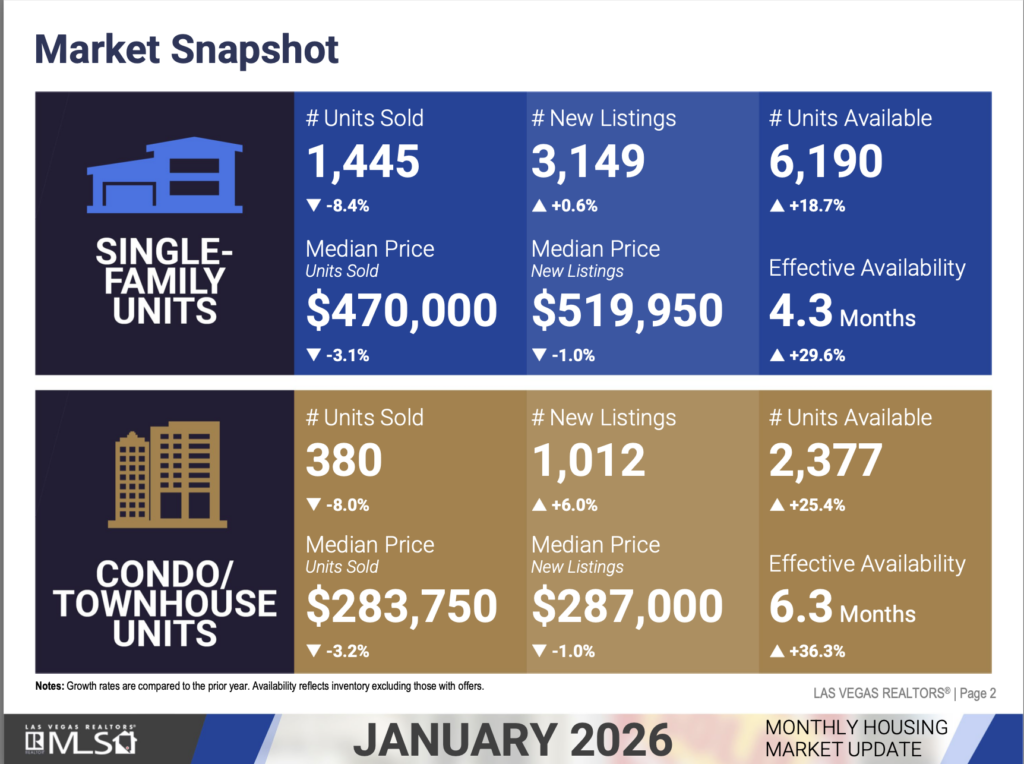
The condo and townhome market has seen a sharper correction, with median prices around $275,000, down from a peak of $315,000 in October 2024. That segment is more sensitive to interest rate pressure and HOA cost increases, and it shows. Single-family homes have held their value considerably better.
For buyers, the price picture means two things. First, you are not buying at the top. The peak was November 2025. Second, you are also not getting a deep discount. Las Vegas prices are still dramatically higher than pre-pandemic levels. The opportunity is in the terms and conditions of the deal, not in finding a distressed market that does not exist.
What I’m Seeing From Buyers Right Now
- Buyers are routinely negotiating closing cost credits of $10,000 to $15,000 from motivated sellers, something that was nearly impossible to get in 2021 and 2022
- Mortgage rate buydowns paid by sellers are now a standard part of most offers. Buyers are getting their effective rate reduced by 1 to 2 points in many transactions
- Luxury homes priced above $1.2M are sitting 90 to 120+ days in many cases, giving serious buyers significant negotiating room on price, inclusions, and repairs
- New construction builders in Summerlin West and Henderson are offering the most aggressive incentive packages I have seen in years, including design center credits of $30,000 to $50,000 on select communities
- Buyers relocating from California are arriving with strong equity from home sales and finding they can buy significantly more home here for the same monthly payment, especially after accounting for the state income tax savings
- Well-priced, move-in ready homes in the $500K to $700K range are still generating multiple offers. The buyer leverage is real, but it is not unlimited. Overreaching on lowball offers is still costing buyers good homes
- Inspection contingencies and repair requests are back. Buyers are no longer waiving these to compete. That is a meaningful shift from two years ago
What Are the Best Neighborhoods to Buy in Las Vegas in 2026?
The strongest neighborhoods for buyers in 2026 are Summerlin West, Henderson master-planned communities, and Mountain’s Edge for value-focused buyers. Each offers a distinct combination of price point, lifestyle, and long-term appreciation potential. The right choice depends on your budget, lifestyle priorities, and whether you prefer new construction or established resale.
The most dynamic real estate opportunity in Las Vegas right now. Eleven new neighborhoods opening in 2026, a coming Urban Core walkable district, and the most significant land releases in Summerlin’s 36-year history at La Madre Peaks. Buyers getting in now are ahead of completed amenities that will drive appreciation. Best for families, move-up buyers, and luxury buyers. See our full Summerlin West insider guide.
Consistently one of the most livable cities in Nevada with a strong appreciation history, excellent schools, and a suburban feel that appeals strongly to relocators. Master-planned communities including Green Valley Ranch, Cadence, and Anthem offer a range of price points. Henderson has a diversified economic base that makes it less dependent on tourism than other parts of the valley.
Strong value for buyers who want master-planned community amenities at a more accessible price point. Both communities have established trail systems, parks, and family-oriented infrastructure. Mountain’s Edge on the southwest side and Skye Canyon in the northwest offer meaningful savings compared to Summerlin while delivering a comparable lifestyle at lower price points.
Appeals to buyers seeking walkability, cultural amenities, and investment upside tied to urban revitalization. Best for young professionals, remote workers, and investors targeting rental yield. A higher-risk, higher-potential-reward play compared to the established master-planned communities.
What Is the Mortgage Rate Outlook for Las Vegas Buyers in 2026?
Mortgage rates entered 2026 on a gradual declining path, briefly touching below 6% for the first time in three and a half years before the U.S.–Israel strikes on Iran in late February pushed them back above 6%. Most forecasters expect rates to settle in the 5.5 to 6.5% range through 2026, with further declines possible if the Federal Reserve cuts rates as projected and the Iran conflict remains contained.
The Federal Reserve was on track to cut rates two to three times in 2026 before the Iran conflict introduced new inflation uncertainty through higher oil prices. Those cuts have not been taken off the table, but the timing is now less certain. Buyers should plan around a 6 to 6.5% rate environment for the near term while staying ready to refinance if rates improve.
One practical implication: for every 0.5% drop in mortgage rates on a $470,000 purchase with 10% down, your monthly payment drops by roughly $140. If rates move from 6.5% to 6%, that is meaningful relief. The buyers who purchase now and refinance later when rates ease are a growing segment of the market, and builders are supporting this strategy with temporary buydown incentives.
Ultra-low rates of 2 to 3% are not coming back in any near-term scenario. Buyers waiting for a return to pandemic-era rates are likely waiting indefinitely. The more strategic approach is to buy at today’s prices with today’s leverage while sellers are motivated, then refinance into a lower rate when the opportunity arises.
Is Las Vegas a Good Real Estate Investment in 2026?
Yes, Las Vegas remains one of the stronger mid-tier investment markets in the country for long-term buyers and landlords. Average rental yields in high-demand areas run approximately 6.2%, multi-family occupancy sits above 90%, and the population growth and migration trends that have driven demand for a decade remain firmly in place.
The long-term investment case for Las Vegas rests on four pillars. First, population growth: Las Vegas continues to attract net in-migration from California, Washington, Oregon, and other high-cost states, driven by affordability and Nevada’s zero state income tax. Second, economic diversification: the valley is growing beyond gaming and tourism into technology, logistics, healthcare, and professional services. Third, supply constraints: land development in Southern Nevada is bounded by federal land ownership on most sides, which limits the supply response to demand. Fourth, the tax advantage compounds for investors, since rental income and capital gains are also free from Nevada state tax.
The risk factors worth monitoring are the tourism-dependent employment base, which can soften during national economic slowdowns, and the condo and townhome segment, which has been more volatile than single-family.
Should You Buy Now or Wait in Las Vegas?
For buyers with stable income, clear timelines, and a home they want to purchase, the case for buying in 2026 is stronger than the case for waiting. The current window of seller motivation, above-average inventory, and negotiating leverage will narrow when rates ease and buyer demand returns. Waiting for perfect conditions in Las Vegas has historically meant paying more.
The honest case for waiting is narrow. If you expect mortgage rates to drop significantly later in 2026, you might get a better monthly payment by waiting. But you will also be competing against the buyers who were waiting alongside you, which tends to push prices and reduce the concessions available today. The buyers who moved in late 2018 during trade war uncertainty, who moved in early 2019 when confidence was low, and who moved in late 2020 when the pandemic market felt uncertain all made excellent long-term decisions.
Timing the Las Vegas market perfectly is a fool’s errand, as Mike Simonsen of Compass noted this week in the context of the Iran conflict. The better question is whether your finances support it and whether you plan to hold long enough for the market to work in your favor. If yes to both, 2026 offers a better entry point than most of the last five years.
Frequently Asked Questions
Is the Las Vegas housing market going to crash in 2026?
No credible forecast calls for a Las Vegas housing market crash in 2026. Distressed sales are below 0.5% of closings, homeowners carry substantial equity, and the structural demand drivers, including population growth and out-of-state migration, remain intact. The market is correcting modestly from peak prices, not collapsing. The 2025 sales volume drop reflects rate-driven hesitation, not fundamental weakness.
Is Las Vegas still affordable compared to California?
Yes, significantly. The typical home in Los Angeles is around $1,025,000 and in San Jose approximately $1,119,000 as of early 2026. Las Vegas median single-family price is $470,000. California buyers who sell and relocate to Las Vegas frequently find they can buy two to three times the space for the same money, plus eliminate state income tax entirely. The affordability gap between Las Vegas and coastal California remains one of the widest in the country.
What is the best time of year to buy in Las Vegas?
November through February historically offers the strongest buyer leverage due to seasonal demand slowdown. Sellers who have not closed by the holidays tend to be more motivated, and fewer competing buyers are active. Spring, particularly March through May, is when demand picks up, competition increases, and seller concessions shrink. Right now, in early March 2026, buyers are in one of the strongest negotiating windows of the year.
How much can I negotiate off the asking price in Las Vegas right now?
It depends heavily on the price range and how the home is priced. In the $500K to $800K range, buyers are commonly negotiating 1 to 3% below asking price plus closing cost credits of $10,000 to $15,000 and seller-paid rate buydowns. Luxury homes priced above $1.2M have more room, with some properties seeing 5 to 8% price reductions from original asking. Entry-level homes under $450K that are priced correctly are still seeing faster sales with less room to negotiate.
Does Nevada’s no state income tax really make a difference for home buyers?
For relocators from California, Oregon, or Washington, it makes an enormous difference. A household earning $200,000 saves approximately $16,000 per year by moving from California to Nevada. That savings recurs every year and can be redirected toward a larger mortgage, a better neighborhood, or long-term wealth building. Over a decade, it represents $160,000 in additional retained income. Read our full breakdown of Nevada’s no state income tax and what it means for your buying power.
Is now a good time to buy new construction in Las Vegas?
Yes. Builders in Summerlin West, Henderson, and other active communities are offering incentive packages that rival the best deals available in the resale market, including mortgage rate buydowns, design center credits, and closing cost contributions. New construction buyers also benefit from builder warranties and modern energy efficiency. The caveat: tariffs on lumber and building materials are adding $9,000 to $17,500 to new home costs nationally, which will flow through to base prices over time. Getting in before those increases fully land is an argument for acting sooner.

Kristin Prough is a licensed Nevada real estate advisor with over 10 years of experience helping buyers and investors navigate the Las Vegas housing market. She specializes in market trend analysis, relocation strategy, and long-term investment planning in Southern Nevada.